Volume I Issue i
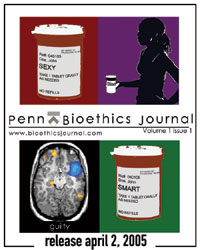
View Full PDF
Contents
-
Letter from the Editor Bo Peng
- Bioethics in the News Markley Foreman, Leila Glass, Tuua Ruutiainen
- Bioethical Issues Facing the Next President Sasha Riser-Kositsky
- Interview: Dr. Jesse Owens (University of Alaska)
Articles
- Hope and Autonomy in the Context of Heart
Transplantation by Kaveh Ardalan, University of Virginia Read Abstract
This article describes and problematizes the
relationship between hope and autonomy. The
author’s conversations with health care professionals
and observations of patient-professional interactions
throughout the course of a Fall 2004 clinical bioethics
internship at the University of Virginia hospital provide
the basis for the analysis and conclusions drawn. The
author argues that the clinical experience of hope is
not morally neutral. Specifically, experiences of hope
and exercises of autonomy are often closely linked
and in tension with one another. At the very least,
false hopes should not be encouraged. However,
even realistic hopes have ethically murky implications
for autonomy. The negotiation of hope and
autonomy should be considered a central issue in
patient-professional relationships.
- The Ethical Consequences of Modafinil Use by Molly Cahill, University Of Pennsylvania Read Abstract
Modafinil is a stimulant that is beginning to
receive attention in the United States because it
lacks the negative physical side-effects of traditional
stimulants. While these side-effects were an
impediment to widespread use of stimulants such
as amphetamines, there is no such barrier to
widespread use of modafinil, and a country as
chronically sleep-deprived as the United States could
be extremely receptive to this drug. The possibility
of widespread use of a neurocognitive enhancer
such as modafinil raises many ethical issues. For
instance, sleep-deprivation is a serious problem in
the United States but a drug that appears to be a
near-perfect treatment for sleep-deprivation may
compromise personal autonomy. Also, as is the case
with all neurocognitive enhancers, modafinil raises
issues surrounding the United States’ cultural
concept of pharmacological Calvinism, according to
which drugs should only be used to treat or cure
illness and disease. Modafinil highlights conflicts
between cultural values concerning effort, success,
and the role of pharmaceuticals in the United States
that will have to be resolved for the drug to assume
a role in society.
- Wrongful Life and Wrongful Birth:
Legal Aspects of Failed Genetic Testing in Oocyte Donation by Kristen N. Carey, Villanova University Read Abstract
The field of reproductive medicine has all but
exploded in recent years, allowing more people access
to novel treatments. New technologies have been
introduced so rapidly that ethics and the law have
been unable to respond appropriately. A particularly
promising reproductive therapy, oocyte donation,
and the wide variety of prenatal genetic tests already
available, will theoretically present the legal world
with a variety of new challenges. How should the
law respond to potential wrongful birth and wrongful
life suits resulting from failed genetic testing, if the
child in question was conceived using a donor egg?
Under what circumstances should the physician be
held liable? Under what circumstances might the
donor be culpable? This paper reviews scholarly
opinions and existing case law in order to answer
these questions.
-
The Real Death of Vitalism: Implications of the Wöhler Myth by Anthony M. Cheng, University of Pennsylvania Read Abstract
There is a tendency for extraneous issues to
unnecessarily complicate bioethical debate. Vitalism
is one of these topics. The implications of the Wöhler
Myth, a popular account of science’s victory over
vitalism, are examined descriptively and normatively:
I reflect on how the Myth’s prevalence shaped the
attitudes of science and religion and evaluate those
attitudes.
- Ethical Implications of Pharmacological
Enhancement of Mood and Cognition by Michael F. Esposito, University Of Pennsylvania Read Abstract
With advances in the molecular biology of
neuroscience, there is an increased understanding
of neurotransmitter systems and the biological basis
of memory and mood. This has lead to the research
and development of highly selective drugs that serve
to alter the brain for treatment and enhancement.
Many ethical concerns arise about the use of
pharmacological agents to alter the brain solely for
enhancement. Safety, alteration of personhood,
distributive justice, and the medicalization of the
human condition will be discussed. However, the
potential to increase one’s memory and efficiency in
the workplace, to eliminate socially undesirable
behaviors, and to strengthen the military provides a
strong argument in favor of pharmacological
enhancement. In conjunction with the ethical
concerns, this paper explores recent research and
current and developing drugs, ultimately arguing that
pharmacological enhancement is acceptable as long
as certain policies are implemented.
-
Clinical Research on the Subject with Dementia: Ethical Concerns and Research Regulation by Nina M. Mirarchi, University of Pennsylvania Read Abstract
While today’s prospective research subjects
enjoy a greater measure of autonomy than those
from the past, investigators must continually strive
to protect vulnerable populations, especially
cognitively impaired older adults with dementia.
Investigators should respect the person’s autonomy,
while also considering the role of beneficence,
nonmaleficence, and justice. The study’s risks must
be weighed against the benefits, and researchers
should obtain their subjects’ informed consent. Since
competence and capacity tests do not always yield
conclusive assessments of cognitive function,
however, proxy decision-makers are sometimes
appointed. Such a framework is problematic. Not
only may proxy decision makers misinterpret the
subjects’ wishes, but they may also ignore them
altogether. In addition, some institutional review
boards have recently been criticized for failing to
protect research subjects. While various commissions
have addressed some bioethical concerns,
controversy remains over whether research on adults
with dementia is ethical given the vulnerability of
these subjects to exploitation.
-
“Soft” Science in the Courtroom?: The Effects of Admitting Neuroimaging Evidence into
Legal Proceedings by Bridget Pratt, Haverford College Read Abstract
There is an ongoing debate regarding the proper
standards for admitting neuroimaging evidence into
legal proceedings. At present, neuroimages are
increasingly being introduced as part of psychiatric
testimony. In courtrooms, however, the idea that
two visibly different brain scans offer proof of insanity
has become increasingly conventional. This becomes
a problem for the criminal justice system because by
understanding neuroimaging evidence in such a
manner, jurors fundamentally misinterpret it.
Furthermore, given the mechanical objectivity
associated with neuroimages, jurors' erroneous
inferences are then afforded undue weight in their
assessments of defendants' mental states. Lawyers
are now able to convey that their clients weren't
rational when they committed their crimes simply
by showing jurors two dissimilar neuroimages. In
order to mitigate the prejudicial effects of such
evidence, it is, therefore, imperative that a new
neuroimaging evidence admissibility standard be
adopted by the American legal system.
-
Euthanasia and Physician Assisted Suicide: Effect on the Doctor-Patient Relationship by Nadine Spigel, University of Pennsylvania Read Abstract
The subjects of euthanasia and physician-assisted
suicide (PAS) serve as controversial topics, not only
in the United States, but all around the world.
Euthanasia, defined as “the hastening of death of a
patient to prevent further sufferings,” has different
forms. These include: voluntary euthanasia,
involuntary euthanasia, and non-voluntary
euthanasia, as well as active and passive euthanasia.
Physician-assisted suicide involves the physician
providing a means in which a patient can end his
life. Many arguments, both positive and negative,
have surfaced concerning how the discussion of
euthanasia and physician-assisted suicide effect the
doctor-patient relationship. Upon examining both
sides closely, the open discussion of euthanasia and
patient-assisted suicide between the doctor and
patient is beneficial, as it will improve both the doctorpatient
relationship, as well as the quality of care
the doctor is able to provide for the patient.
-
Pediatric Cochlear Implants: The Great Debate by Aviva Weinberg, University Of Pennsylvania Read Abstract
The rise and refinement of the cochlear implant, a
device meant to correct for sensorineural hearing
loss in prelingually deaf children, has faced much
debate and criticism. The controversy over this
corrective technology has revealed a significant social
divide between the hearing and the non-hearing
parents of these deaf children. While the hearing
parents welcome the implant as an exciting new
medical remedy for their children’s deafness, the nonhearing
parents reject the implant as a tool of
discrimination. The source of this divide seems to lie
in two very different operative paradigms for
deafness: the pathological and the sociocultural. The
hearing parents’ pathological view places deafness
as an auditory deficit meant to be repaired, while
the non-hearing parents view deafness as a
sociocultural identity. Understanding these divergent
social perspectives sheds light on the heavy
controversy surrounding the cochlear implant and
its hopes for future use.
For information on obtaining a hard copy of
Penn Bioethics Journal Vol 1 Issue i, please see our
Subscription section.