Volume II Issue i
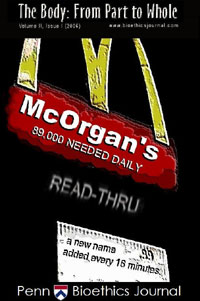
View Full PDF
Contents
-
Letter from the Editor Andrew Rosenthal
- Interview: Francis Delmonico, MD (Massachusetts General Hospital; OPTN/UNOS)
- Interview: David J. Undis (LifeSharers)
Articles
- Psychedelic Psychotherapy: The Ethics of Medicine for the Soul by Brian Anderson, University of Pennsylvania Read Abstract
Psychedelic drugs like LSD and MDMA (Ecstasy) are
known to have profound psychological effects on
people. These substances are now being evaluated
in clinical trials in the US as aids to psychotherapy.
The use of these substances in Transpersonal
Psychology is thought to help patients by inducing
spiritual experiences that lead to improved mental
health. Some people challenge the claim that
authentic spiritual experiences can be induced by
drugs and still others question whether spirituality
have any place in medicine at all. The potential
emergence of the use of psychedelics in medicine
calls for a consideration of these and many other
concerns.
- Ethical Considerations on Organ Transplantation in China by Changmin Jiang, Peking University Health Science Center Read Abstract
Although organ transplantation in China began almost
10 years later than in western countries, it’s
undergoing a rapid change these years. Now, Chinese
hospitals are witnessing that they can operate almost
all kinds of organ transplantations, clinically or
experimentally. Take kidney transplantation as an
example. By the end of 2000, China had performed
34,832 kidney transplantation operations. In the year
of 2001 alone, 5,561 transplantations were done
(Nanyan, 2004). While technology is no longer a
major problem, it is still not an easy topic. It is a
perfect example to show that sociological and ethical
considerations often lag behind science and
technology. Nowadays, organ transplantation is facing
a lot of social and ethical problems which are quite
complicated and related to many areas of social life.
In this paper, I would like to share some phenomena
surrounding organ transplantation in China and my
considerations on ethical issues about organ
resources and allocation.
- Selling with Dignity: Organ Selling and the Safeguarding of Human Dignity by Julia Josepha, University of Toronto Read Abstract
With increasing wait times to receive an organ
transplant, there is a rising need to institute a more
efficient organ procurement system. As an incentive
for organ donation, it has been suggested that
money be given to donors. Yet many maintain that
human dignity, as characterized by Immanuel Kant,
would be destroyed should organ selling become
legalized. This assertion, one interpretation of Kant’s
conception of dignity, further claims that a monetary
amount could never compensate for the loss of
dignity. However, an alternative interpretation of
Kant’s definition insists that dignity would not be
destroyed during an organ sale, and argues that a
price does not always denote something’s entire
worth. This paper explores these two opposing
interpretations of Kant’s characterization, ultimately
arguing that accepting the latter interpretation
would lead to both a reduced occurrence of
preventable, unwanted deaths and a preservation
of human dignity.
-
Critical Objections to Michael Steinberg’s Opt-In System for Kidney Transplantation by Matthew Kelly, Brown University Read Abstract
The growing realization that kidney diseases are a
significant contributor to morbidity and mortality in
this nation has prompted discussion regarding the
availability of kidneys for transplant operations.
However, the current dearth of donated kidneys
keeps the number of transplant operations low. David
Steinberg rejects current kidney transplant practice
and, instead, proposes an “Opt-In” model for
donated kidneys to attempt to remedy the low
availability for donated kidneys. Here, I argue that
the Opt-In model (i) inappropriately privileges merit
over need for medical resource allocation decisions,
and (ii) needlessly privileges like-reciprocation in the
construction of a system that forces a comparison
of two incomparable rights. The use of this meritbased
resource distribution paradigm presents
individuals with a contract that effectively coerces
them into unfairly sacrificing one right for the sake
of another.
- The Medicated Self: Implications of Prozac on Selfhood, Embodiment and
Identity by Cara Rabin, University of Pennsylvania Read Abstract
As knowledge about molecular neurobiology and
genetics has grown and as biotechnology is
increasingly able to modify and moderate what was
once considered permanently determined by our
biological and genetic fate, selective serotonin
reuptake inhibitors, particularly Prozac, have been
pushed to the forefront of bioethical debates. The
use of Prozac and other pharmacological interventions
in the brain raises concerns that other aspects of
biotechnology have not. The brain is considered the
seat of mind and consciousness: Therefore,
interventions in the brain have a unique set of ethical
implications. Though today we can alter many things
about ourselves with great ease, the use of Prozac
has broadened the scope of changes we can make
to our moods, temperaments and feelings. This
article aims to open an essential dialogue about
Prozac’s impact on identity and selfhood.
-
Transplantation of Ovarian Tissue by Alix Rogers, University of Pennsylvania Read Abstract
New transplantation procedures such as the
transplantation of ovarian tissue raise especially
complex ethical and legal questions associated with
organ transplantation. This paper discusses two ways
that ovarian tissue transplants could be performed,
namely re-implantation and transplantation from
donor to recipient. Focusing on issues of
reproduction, this paper then examines these two
procedures under the light of concerns over the
medicalization and commodification of reproduction,
interpretations of reproductive rights and safety. I
conclude with the expectation that ovarian tissue
transplantation will become ethically and legally
acceptable in the distant future.
-
Assessing the Ethicality of Pre-implantation Genetic Diagnosis beyond the
Discourse of Eugenics by Faraz Siddiqui, University of Toronto Read Abstract
Pre-implantation genetic diagnosis (PGD) is often
seen as the inevitable return of eugenics “through
the back-door”. Recent advances in genetics have
certainly resurrected the prospects of human artificial
selection, but fundamental differences between the
two in aims and ideology as well as methods and
potentials render this label tenuous. This paper
highlights these differences to challenge commonly
applied similarities and calls for a re-examination of
PGD beyond the nostalgic paranoia of eugenics.
Referring to PGD as eugenics is doubly
disadvantageous. Firstly, the reminiscence it provokes
of the Eugenics Movement restricts our discourse*
when we assess the ethicality of the use of PGD
and unnecessarily compromises an otherwise
beneficial tool against genetic diseases. Secondly,
only after we see beyond this discourse can we
recognize and tackle the more realistic ethical issues
of PGD. Such issues are assessed in this paper and
their implications for bioethics are explored.
-
Emergency Contraception: Balancing a patient’s right to medication with a
pharmacist’s right of conscientious objection by Hannah Shacter, University of Pennsylvania Read Abstract
Emergency Contraception (EC) is a safe and effective
way to prevent pregnancy after having unprotected
sex. Plan B, a form of EC, is 95% effective at
preventing pregnancy when taken up to 24 hours
after unprotected sex. Therefore, timely access to
Plan B is key to its efficacy. Many pharmacists,
however, refuse to fill prescriptions for EC due to
their moral or religious beliefs. There is a growing
conflict between the right of patients to receive
timely access to their medications and the right of
pharmacists to refuse to fill prescriptions to which
they are morally opposed. Recent legislation on the
state level has attempted to deal with the problem,
but has not mitigated the conflict. Future policies
must ensure that patients have access to their
medications while still respecting the ethical concerns
of pharmacists.
-
Person in PVS: An Oxymoronic Bioethical Issue? by Noah T. Sugerman, University Of Pennsylvania Read Abstract
The 2005 legal battle over the fate of Terri Schiavo
garnered intense media coverage and sparked a
nation-wide debate over the so-called “right to life”
of patients in a persistent vegetative state (PVS).
This paper explores the ethical side of the PVS issue.
After presenting the medical definition of PVS, as
well as the diagnosis and prognosis of the condition,
I investigate possible definitions of personhood and
death in an attempt to discover whether or not Ms.
Schiavo deserved full rights as a person. I then look
at the arguments and reasons on all sides of the
issue and examine the implications of choosing
various definitions of personhood and death. Finally,
I propose a possible solution to the ethical dilemma
of PVS patients and analyze the effects such a
solution would have on our society and morals.
For information on obtaining a hard copy of
Penn Bioethics Journal Vol II Issue i, please see our
Subscription section.