Volume V Issue i
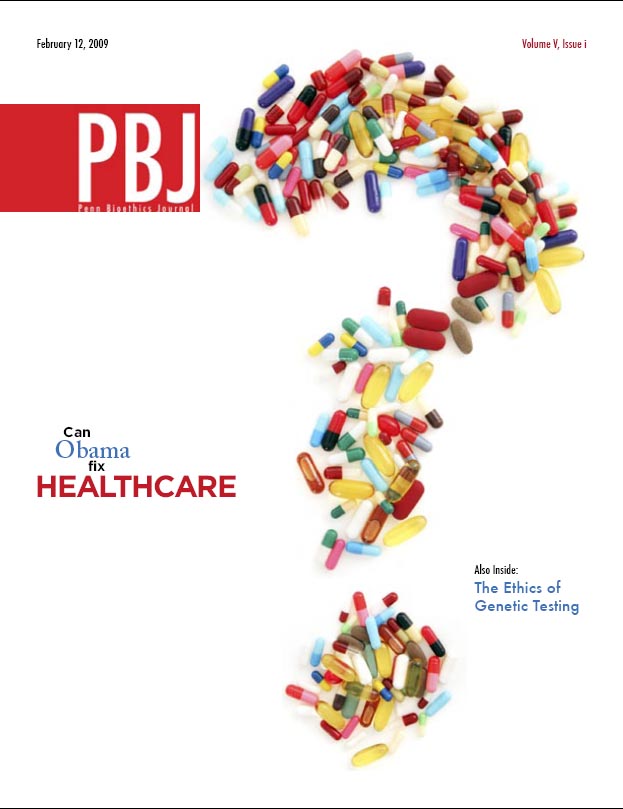
View Full PDF
Contents
-
Letter from the Editor Bo Peng
- Bioethics in Brief Leila Glass, Tim Pian, Nayan Ramirez, Tuua Ruutiainen
- Obamaʼs Healthcare Problem Vishesh Agrawal
- Interview: Dr. Hank Greely (Stanford University)
- Interview: Dr. Albert Yan (Children's Hospital of Philadelphia and University of Pennsylvania School of Medicine)
- Civil Rights of the Mind Katie McCarthy
- To Feed or Not to Feed? Daniel Albornoz
Articles
- Ethical Issues in the Advent of Genetic Testing by Benjamin Schanker Read Abstract
Genetic information is continually emerging in medicine, health care, policy, and social evolutions. Since the discovery of the structure of DNA in 1953 and
the completion of the Human Genome Project in 2003, our understanding of the genetic bases of life has grown considerably. Association studies have
indicated that having certain genes may significantly increase an individualʼs susceptibility to developing various cancers, hypertension, heart disease, and
numerous other conditions. Genetic information has the potential to change clinical practice and reform health care in the future. But the ability to test for
genetic mutations and disease susceptibilities carries numerous ethical implications. This paper outlines several core ethical issues raised in the growing
application of genetic testing and makes recommendations for testing policies. Among other requisites, oversight of genetic testing is necessary to protect
patients and avoid unnecessary expenditures.
- Humanitarianism and Human Rights:
Tensions in Médecins sans Frontières by Laura Harris Read Abstract
One of the worldʼs most respected medical humanitarian organizations, Médecins Sans Frontières (Doctors Without Borders, MSF) has a complex relationship
with the use of human rights discourse, one that has evolved throughout its history. Accusations of human rights abuses heavily implicate states, both as the
parties responsible for violations and those charged with the duty of international intervention to stop these violations. MSF tries to remain relatively neutral
in order to relieve the suffering of those in need more effectively; it prefers using humanitarian discourse in order to avoid the national and international
implications in accusations of human rights abuses and is vocal about separating humanitarianism from other forms of action. However, while many humanitarian
organizations keep to a strict policy of neutrality, MSF does sometimes use human rights discourse and counts témoinage – the witnessing and
reporting of suffering – as a central component of its mission. This paper analyzes several facets of MSFʼs rhetoric and actions to delve into the complexities
of applying a human rights framework to the work of humanitarian groups. It concludes that relying too heavily on human rights discourse would weaken
humanitarian groups, but that the most intelligent groups – such as MSF – use a pragmatic approach to blend human rights with humanitarianism and
medical appeals to form a more robust framework for action. When they recognize that a situation can benefit significantly from political appeals in the vein
of human rights, they will use human rights discourse to further their mission of relieving human suffering.
- End of Life Issues in Judaism and a
Comparison to the American System by
Jennifer Chevinsky Read Abstract
Many of the earliest treatises on medical bioethics were derived from Jewish theologians and ethicists. Although derived from similar sources, the traditional
Jewish view of end of life issues is not always comparable with American judicial rulings. In this paper, American judicial rulings are incorporated primarily
for clarification purposes, in order to highlight the differences between the two perspectives. Realizing that American bioethical decisions are not necessarily
uniform, sometimes differing from state to state or between states and the federal government, this paper discusses some specific cases and majority views.
The Judaic perspective on end of life care is based on the premisesof the preservation of human life, respect and awe for the human body, and sensitivity
towards the apparent tribulations. Although the American system stresses the flexibility of autonomous moral decisions when determining legislation, there
are also guidelines and restrictions based largely on legal precedence. Topics such as the instance of death, view on life, organ donation, abortion, and autopsies
are reviewed in light of both perspectives. For some issues, both systems agree such as on the instance of death, while in others, such as establishing
a view on life, the two differ. In others still, there are varying degrees of agreement, such as the confluence in opinion between Jewish ethicists and most
American judicial rulings strongly encouraging organ donation, though it is not obligatory in either case.
For information on obtaining a hard copy of
Penn Bioethics Journal Vol V Issue i, please see our
Subscription section.